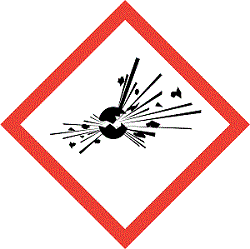
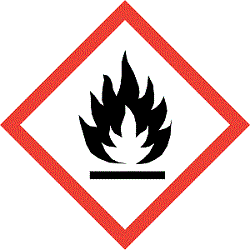
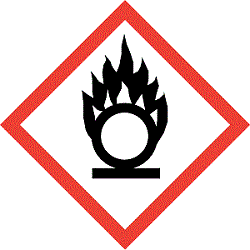
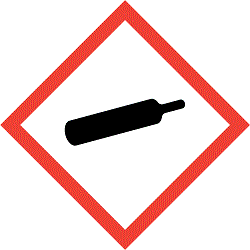
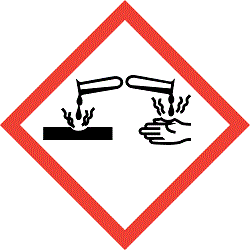
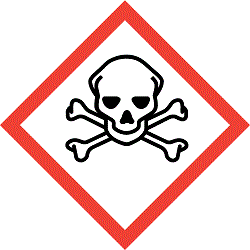
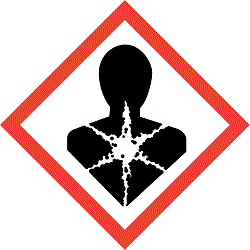
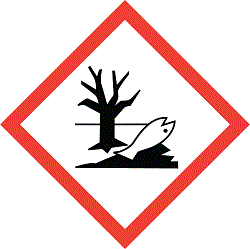
GHS pictograms are standardized hazard symbols used globally to communicate specific hazards of chemicals. Each pictogram consists of a symbol on a white background within a red diamond border. This comprehensive guide covers pictogram usage, classification criteria, and precedence rules according to CLP Regulation (EC) No 1272/2008.
Destruction of skin tissue within ≤ 3 minutes exposure
GHS05
1B
Destruction of skin tissue within > 3 minutes to ≤ 1 hour exposure
GHS05
1C
Destruction of skin tissue within > 1 hour to ≤ 4 hours exposure
GHS05
2
Mean value of 2.3-4.0 for erythema/eschar or edema
GHS07
2.3 Environmental Hazard Classification
Category
Acute Toxicity
Chronic Toxicity
Pictogram
Acute 1
LC50/EC50 ≤ 1 mg/l
-
GHS09
Chronic 1
LC50/EC50 ≤ 1 mg/l
Not rapidly degradable or BCF ≥ 500
GHS09
Chronic 2
1 < LC50/EC50 ≤ 10 mg/l
Not rapidly degradable or BCF ≥ 500
GHS09
Chronic 3
10 < LC50/EC50 ≤ 100 mg/l
Not rapidly degradable or BCF ≥ 500
No pictogram
3. Pictogram Precedence Rules
Key Precedence Rules:
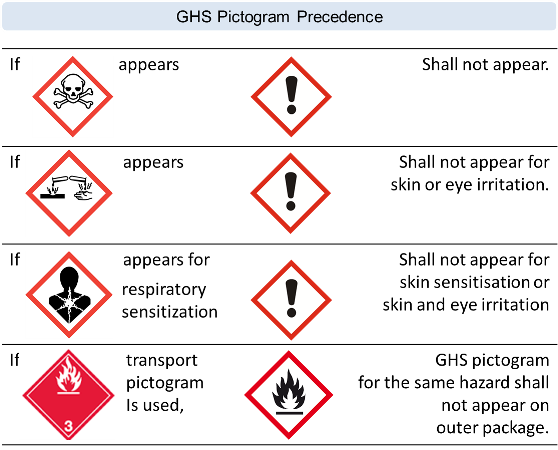
If GHS06 (skull and crossbones) applies, GHS07 (exclamation mark) shall not appear
If GHS05 (corrosion) applies, GHS07 (exclamation mark) shall not appear for skin or eye irritation
If GHS08 (health hazard) applies for respiratory sensitization, GHS07 (exclamation mark) shall not appear for skin sensitization or skin/eye irritation
For substances with multiple hazards, all relevant pictograms shall be used unless specific precedence rules apply
3.1 Multiple Hazard Scenarios
Scenario
Primary Pictogram
Secondary Pictogram
Notes
Acute Tox. (Cat. 2) + Skin Irrit. (Cat. 2)
GHS06
None
GHS07 omitted due to precedence rule
Skin Corr. (Cat. 1) + Eye Irrit. (Cat. 2)
GHS05
None
GHS07 omitted for eye irritation
Flam. Liq. (Cat. 2) + Carc. (Cat. 1)
GHS02
GHS08
Both pictograms required
4. Special Considerations
4.1 Transport Packaging Requirements
GHS pictograms not required on outer packaging when transport pictograms are present
Minimum size requirements: 1 cm² on labels
Must be clearly visible and indelible
Must contrast with background
4.2 Supplemental Hazard Information
Additional EUH statements may be required for specific hazards not covered by standard pictograms:
EUH001: Explosive when dry
EUH014: Reacts violently with water
EUH029: Contact with water liberates toxic gas
EUH066: Repeated exposure may cause skin dryness or cracking
EUH070: Toxic by eye contact
EUH071: Corrosive to the respiratory tract
Important Implementation Notes:
Multiple pictograms may be required for substances with multiple hazards
Precedence rules must be followed when certain combinations of hazards exist
Pictograms must be clearly visible and at least 1 cm² in size on labels
The red diamond border is mandatory for all GHS pictograms
Regular review of classification is required as new data becomes available