Different Variants of SDS Across the World
Although the Globally Harmonized System (GHS) has introduced standardised communication for SDS, countries have adopted these standards differently into their legislations.
Regional Implementations
Major Regions
- Australia. Australia has a Model Code of Practice - Preparation of Safety Data Sheets for Hazardous Chemicals available in both .pdf and .docx format. Australia also has a site focused on hazardous chemicals.
- Canada. Canada has the Workplace Hazardous Materials that put in place the requirements for SDS in workplaces. This is also administered federally by Health Canada under the Hazardous Products Act, Part II, and the Controlled Products Regulations.
- European Union. SDS is part of the system of the Regulation (EC) No 1907/2006 (REACH). While the original requirements of REACH for SDS have adapted the GHS, the other elements of the GHS into the EU legislation were also implemented. Meanwhile, the European Chemicals Agency (ECHA) has also published a guidance document about the SDS.
- Germany. SDS must be compiled according to the REACH Regulation No. 1907/2006. When it comes to the national aspects, the requirements are defined in the Technical Rule for Hazardous Substances (TRGS) 220, "National aspects when compiling safety data sheets".
- Mexico. Mexico has also adopted the GHS for its identification, risks, and communication of hazards in the workplace since October 2018.
Additional Regions
- The Netherlands. Also known as veiligheidsinformatieblad or Chemiekaarten, the Dutch Safety Data Sheets or the Safety Data Sheets is a collection of the most widely-used chemicals. This book is available for commercial use, and also available in some websites.
- South Africa. South Africa has different organisations covering the handling of hazardous chemicals. Among them include the International Maritime Organisation (IMO), the International Civil Aviation Organisation (ICAO), and the International Air Transport Association (IATA) which gives regulations on the transport of hazardous goods. South Africa has also executed common laws which are laws based on practise and custom.
- United Kingdom. Originally, the Chemicals Hazard Information and Packaging for Supply Regulations 2002 known as CHIP Regulations cover the SDS. But now the Control of Substances Hazardous to Health (COSHH) Regulations govern the use of hazardous substances in the work environment in the UK and particularly require the assessment of hazardous substances.
- United Nations. The United Nations (UN) gives certain details such as the UN numbers used to figure out the hazardous materials in a standard form.
- United States. In the US, the Occupational Safety and Health Administration (OSHA) requires that employees provide SDS in the work environment, under the Hazard Communication regulation. Under Section 311 of the Emergency Planning And Community Right-to-Know Act, the SDS should be made available to all state and local emergency planning officials and local fire departments.
Asian and Middle Eastern Regions
- Turkey In Turkey, the regulation governing Safety Data Sheets (SDS) is the KKDIK regulation, which aligns with the EU REACH regulation. As of December 31, 2023, all SDSs must be prepared by Chemical Assessment Experts (KDU) according to KKDIK Annex II. The SDSs must be in Turkish and submitted to the Integrated Environmental Information System (EÇBS).
- China China has adopted the UN GHS system and implemented it through several national standards. The key standards for SDS in China are GB/T 16483-2008 and GB/T 17519-2013. China is transitioning to a new GHS standard (GB 30000.1) based on the eighth revised edition of the UN GHS, effective August 1, 2025.
- Russia In Russia, the requirements for SDSs are governed by the Technical Regulation on Safety of Chemical Products. SDSs must be prepared according to GOST 30333-2007. SDSs in Russia are called Chemical Safety Passports (CSP) and must be registered in the CSP Register.
- Japan In Japan, SDS requirements are governed by the Industrial Safety and Health Law (ISHL) and the JIS Z 7253 standard. From April 1, 2023, it is mandatory to review health hazards every 5 years and update SDSs if necessary.
Other Regions
- Serbia Serbia is aligning its chemical legislation with EU standards. As of September 1, 2024, all SDSs in Serbia must comply with the latest EU REACH format.
- N-Korea In South Korea, SDSs are regulated under the Occupational Safety and Health Act (K-OSHA). Korean SDSs must be prepared according to the Ministry of Employment and Labor Public Notice #2016-19.
- Colombia Colombia has adopted the GHS through Decree 1496/2018, implementing the 6th revised edition of GHS.
- Thailand Thailand has adopted the UN GHS system, with implementation effective from March 13, 2017.
- Philippines The Philippines has implemented GHS through Guidelines for Chemical Safety Program in the Workplace.
- Brazil Brazil has updated its national standard for GHS implementation, ABNT NBR 14725:2023, mandatory from July 4, 2025.
- Chile Chile has implemented GHS Rev. 7 through regulations published on February 9, 2021.
- Costa Rica Costa Rica implemented GHS through two executive decrees in 2017.
- Gulf Cooperation Council (GCC) The GCC is working on implementing GHS Rev. 7 through draft standard GSO/TC01/DS/GSO2654:2023.
- Israel Israel's SDS requirements are governed by the Work Safety Regulations of 1998.
- Kenya Kenya has included GHS implementation in its National SAICM Implementation Plan.
- New Zealand New Zealand regulates SDS under the Hazardous Substances (Safety Data Sheets) Notice 2017.
- Pakistan Pakistan has numerous Acts for chemical management but no specific SDS regulations.
- Rwanda Rwanda has regulations governing hazardous waste services and labeling requirements.
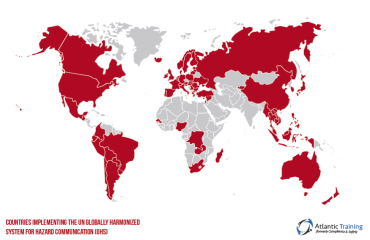
Although some regions have different regulations in place, all of them are based under the Globally Harmonized System (GHS).
Key Considerations in SDS Variations
Important Differences Between Countries
- Although countries have common GHS standards, there is no harmonisation between countries. The United Nations created the GHS with a building block approach, allowing the countries to adopt the standards based on their jurisdictions.
- Every country has different regulations for the environment and transportation. On top of the GHS standards, every country has unique regulations that should be included in the SDS.
- Local classifications and regulations keep changing. Depending on particular circumstances, local classifications and regulations keep changing.
- Classification of substances differs between countries. With different variations adapted by various countries, substances are classified differently between jurisdictions.
Dynamic Factors
- Toxicity data changes. With new data being published every day on the effects of toxicity on humans, the environment, and animals, research constantly evolves.
- Exposure scenarios can be hard to predict. Those coming up with the SDS can predict possible exposure scenarios, depending on the type of work and the circumstances surrounding the work environment.
- Cut-off exposure can differ between countries. What is considered acceptable in this country may not be in another, or may have bigger restrictions.
- Ingredients may be allowed in one country and not in another. Canada, for instance, allows approximately 23,000 substances approved for import, use, and manufacture.
- Confidential business information may be withheld. In some countries, their confidential business information may be withheld or kept under wraps.