GHS Precedence Rules for Pictogram, Signal Word and Hazard Statement
For a hazardous chemical classified with multiple hazards, it is very important that we use prioritized GHS pictogram, signal word or hazard statements to communicate the most significant hazards first.
In this article, is summarized the main GHS precedence rules for pictogram, signal word, hazard statement and precautionary statements.
Precedence Rules for GHS Pictograms
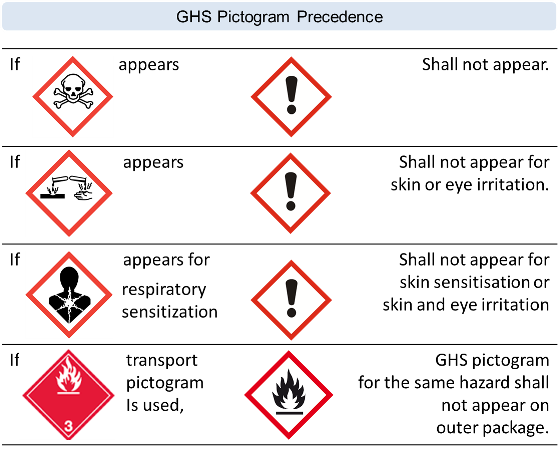
For health hazards: Exclamation mark should not appear if:
- if skull and crossbones applies; or;
- if used for skin sensitization or skin/eye irritation;
- If corrosive pictogram applies; or
- If the health hazard pictogram appears for respiratory sensitization.
The picture below summarizes GHS pictogram precedence.
Precedence for Signal Words
If "Danger" is used, "warning" should not appear. Only one of them needs to appear on a label.
Precedence Rules for Hazard Statement
All hazard statements should appear on a GHS label, except those as specified below:
- If H410 "Very toxic to aquatic life with long lasting effects" is assigned, H400 "Very toxic to aquatic life" may be omitted
- If H411 "Toxic to aquatic life with long lasting effects" is assigned, H401 "Toxic to aquatic life" may be omitted
- If H412 "Harmful to aquatic life with long lasting effects" is assigned, H402 "Harmful to aquatic life" may be omitted
- If H314 "Causes severe skin burns and eye damage" is assigned, H318 "Causes serious eye damage" may be omitted
Even though different competent authorities may decide whether to use above precedence rules or not, most of countries have adopted above rules when implementing GHS.
Precedence Rules for Precautionary Statement
There is no standard precedence rule for precautionary statements in UN GHS. You may include all precautionary statements on a GHS label (code is unnecessary). However, many competent authorities (EU, Korea, and Australia) have limited the number of precautionary statements on a label to make a label more readable.
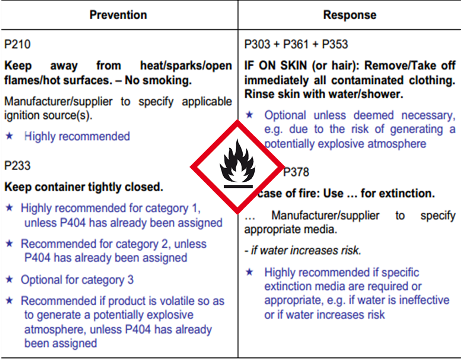
ECHA's guidance on classification and labelling has classified all precautionary statements into four categories: highly recommended, recommended, and optional and not to be used. Normally you can include highly recommended or recommended ones.
The picture below shows how precautionary statements are categorized for a flammable liquid in ECHA's guidance. If you wish to read more, please click the picture to download the guidance.
Key Principles of Pictogram Precedence
- The exclamation mark pictogram should not appear if a more severe health hazard pictogram (e.g., skull and crossbones, health hazard) is required.
- If both the skull and crossbones (acute toxicity) and health hazard (long-term effects) pictograms are applicable, the skull and crossbones takes precedence.
- For physical hazards, the exploding bomb (explosive) takes precedence over other physical hazard pictograms such as the flame or gas cylinder.
Example 1: Flammable Liquid with Acute Toxicity
- Pictograms: Skull and crossbones (acute toxicity) takes precedence over flame (flammable)
- Signal Word: Danger
- Hazard Statements:
- H225 - Highly flammable liquid and vapor
- H300 - Fatal if swallowed
Example 2: Carcinogenic with Skin Irritation
- Pictograms: Health hazard (carcinogenicity) takes precedence over exclamation mark (skin irritation)
- Signal Word: Danger
- Hazard Statements:
- H350 - May cause cancer
- H315 - Causes skin irritation
Pictogram Precedence in the UK Post-Brexit
The UK continues to follow GHS principles under GB CLP Regulation but may diverge from EU practices in the future. Key points include:
- The UK recognizes GHS pictogram precedence rules as outlined in Annex I of GB CLP Regulation
- No immediate changes to pictogram or hazard statement requirements have been implemented post-Brexit
- SDSs must comply with GB-specific requirements while aligning with international standards where possible
The accuracy of label elements is critical for regulatory compliance and effective hazard communication. Suppliers must ensure that all information is up-to-date and aligned with global standards while addressing regional variations like those in the UK post-Brexit.